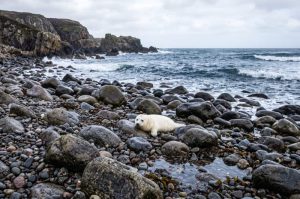
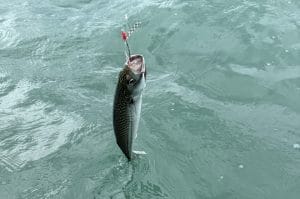
I should start this post with a candid statement : I am probably the last person you should listen to for fishing advice!
My track record of fishing in general is pretty poor. Whilst I have had some fairly epic mackerel fishing over the years in Newport, my sum total of success whilst spinning for bass is one (massive) fish that got away, so nobody actually believes that I caught one 🙂
Whilst my credentials to write a post about fishing are therefore highly suspect, I can boast many hours enjoying the big outdoors with a fishing rod in my hand so I hope I have some degree of credibility….
With the River Nevern, Newport Bay and miles of rocky Pembrokeshire coastline on the doorstep, Newport is an excellent base for anyone who enjoys fishing. There is plenty of variety, whether you are a hopeless dreamer like me or an experienced angler.
Here are my thoughts, based on many years not catching much and ably assisted with some Google research:
Sea fishing around Newport
For most, sea fishing is probably the easiest place to start. Traeth Mawr (the main beach at Newport Sands), the Parrog and the rocky coastline around Dinas Head all offer great fishing, although the type of fishing and the species you are likely to encounter vary considerably.
The Parrog sits at the mouth of the Nevern Estuary and offers relatively sheltered fishing. Species recorded here include bass, pollack, whiting, plaice and flounder. Fish the edges of the main channel rather than the slack shallows, and go on a flooding tide if you can. You will often see people fly fishing in waders along this stretch.
Newport Sands (Big Beach) gives you classic beach fishing. Bass are the main target, but anglers can also encounter plaice, flounder and dab, with the possibility of a thornback ray.
I have never actually fished right off the beach but have enjoyed many dog walks watching people cast bait over the surf.
The rocky coastline towards Dinas Head is much more exposed, so conditions and safe access need to be taken seriously but it can be magical. If you walk the coast path south west from the Parrog, past the old lifeboat station towards Cwm, there are various flat rock platforms with reasonable access from the path.
This is also where I have personally enjoyed most of my not-catching, using a spinning rod and a variety of lures, which all promise to be bass magnets but I must have put them on wrong as they seem to repel rather than attract 🙂
It is especially glorious on this stretch later in the evening as the sun goes down, as this timelapse video (from many moons ago) shows:
That isn’t me fishing, but you can hopefully get a taste of just how beautiful it is to fish off the rocks. Nature at its finest. Did I tell you about the behemoth that got away? Honestly, it was enormous.
The most common species in Newport
Bass
Bass are probably the most exciting fish you can realistically target from the shore around Newport.
They move into shallower coastal water and estuaries as conditions warm, making late spring through to autumn the main period. The main beach should be one of the best places to try, as bass typically patrol surf beaches looking for food, while the estuary and rocky areas provide other opportunities.
Smaller school bass are relatively common. Larger fish are certainly possible but you need to be mindful of the regulation of bass fishing, with rules covering minimum sizes, closed periods and how many fish can be retained. At the time of writing there is a 42cm minimum size, a bag limit of three fish per angler per day, and a catch-and-release-only period covering February and March. These rules change from year to year, so always check the current position before you keep anything.
Grey mullet
Mullet are the fish that you are most likely to see swimming up the estuary. Ali and I had a walk back to Peg-y-Don one magical evening when the river was teaming with mullet as you crossed over the iron bridge. I was tempted to dash back with a rod, but knew that it would be hopeless…
There are apparently three species of mullet that turn up around the Welsh coast. Thick-lipped grey mullet are the most widespread and the most likely fish in the Nevern estuary, where they favour the channel and areas of flow. Golden grey mullet, the smallest of the three, prefer sand within estuaries, harbours and surf beaches, so the big beach is worth a look on a warm, settled summer day. Thin-lipped mullet are the least likely of the three here, but not impossible, and are best identified by the dark spot at the base of the pectoral fin.
As I aluded to above, they are not easy to catch even if you are good at fishing – they have a reputation as one of the hardest fish to catch in British waters. You will usually see them long before you catch them, cruising just under the surface of the water, entirely aware of you and entirely unbothered by you.
If you want to give it a go then bread, small ragworm or a bit of mashed bread groundbait are the the most recommended approaches.
Mackerel
If there is one fish associated with a summer holiday by the sea, it has to be the mackerel. They are probably the easiest fish to catch, in terms of skill / equipment required, and taste absolutely amazing if you can get them on the bbq moments after catching them.
Mackerel generally arrive around the Pembrokeshire coast as the sea warms and shoals of baitfish move inshore. Summer is the prime period, although exactly when they appear varies according to sea temperature, weather and food availability.
Ideally, you need access to a boat to enjoy the mackerel fishing in Newport. There are some marks around the cliffs that can work, but you will tend to see a flotilla of boats heading out to Morfa Head to try their luck. We have always called the lump of rock that is just off the cliffs ‘Mackerel Rock’ as this is where we have had most success and where most of the boats cluster. I think the rock is officially called Carreg Edrywy, but Mackerel Rock is more apt in my humble opinion.
Mackerel tends to be either nothing at all or complete chaos, with very little in between. You can fish for an hour convinced the sea is empty, and then the shoal arrives and everyone is catching three at a time and whooping with joy. It is rare to blank entirely, in my experience, although we did fail to catch a single mackerel on our last trip in May – it was very weird. I blame the dolphins and seals (or off-shore mega trawlers?).
If you want to improve your odds, Fishguard has various boat trips on offer. Skippers along this coast run everything from ninety-minute mackerel trips that children love to full days over the deep wrecks of the Celtic and Irish Seas for pollack, ling and conger.
Pollack and wrasse
Rockier sections of the Pembrokeshire coast provide habitat for pollack and ballan wrasse. I have to be honest and admit that I am always a bit disappointed when we catch pollack on the feathers as mackerel tastes so much better, but we have caught many over the years.
Pollack tend to patrol around rocks, kelp beds and deeper water, while wrasse are very much associated with rough, rocky ground. Both become more active as the water warms, making late spring, summer and early autumn the most productive period. Float-fished ragworm is a reliable approach for wrasse.
Wrasse in particular can be surprisingly powerful fish, even when they are not especially large. They are also very good at finding the one rock capable of parting you from your tackle…
Flatfish
There are several species of flatfish that can be caught in and around Newport.
Flounder are perhaps the most obvious estuary species, while plaice and dab can also be caught locally. Newport Sands is associated with all three, and both plaice and flounder can be found around the Parrog.
Unlike mackerel, which are very much associated with warmer weather, flatfish help extend the fishing season well beyond the height of summer.
Dogfish, rays and conger eels
If you fish after dark or venture onto rougher ground, the list of possible species grows considerably.
Lesser-spotted dogfish are common around much of the Pembrokeshire coast and can turn up when fishing with bait, particularly after dark. Conger eels are another possibility around rocky ground, while thornback rays can be encountered from some of the sandy beaches and coves in the area.
Cwm-yr-Eglwys, for example, is associated with bass, pollack, dab, thornback ray and lesser-spotted dogfish.
Peggy (our dog) loves splashing around in the river in front of the lifeboat station and does occasionally bring us some fish, the most impressive of which has to have been this dogfish:
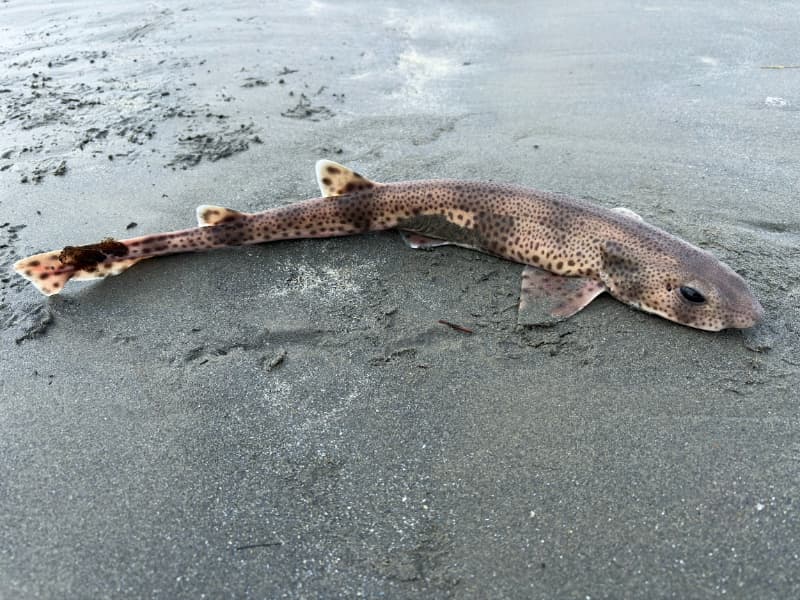
You will be pleased to know that she didn’t seem too upset with our ‘catch and release’ approach to this particular fish and it seemed to be relatively unphased by the whole encounter…
Fishing the River Nevern
It isn’t all about the sea fishing.
The River Nevern, or Afon Nyfer, flows down from the Preseli Hills before entering the sea at Newport. It is one of Pembrokeshire’s principal migratory salmonid rivers and supports brown trout, sea trout and salmon. It is a small, tree-lined spate river, the sort of water where a ten-foot rod is plenty and the fish are usually closer than you think.
For many anglers, the real prize is the sea trout, known in Wales as sewin. These remarkable fish spend part of their lives at sea before returning to freshwater. Sewin generally start running from the beginning of May, with the fishing peaking in July, and grilse appearing from around the same point in the summer. Salmon tend to arrive from August through to the close of the season.
Sewin fishing here is largely a night game unless the river is up after rain. There is a particular kind of evening in July where you are standing in the dark in a Welsh valley, an owl is going off somewhere upstream, something splashes that you decide to believe was a fish, and you do not get so much as a pull for three hours. Pure bliss.
Fishing the Nevern is very different from wandering onto the beach with a rod, however. You will need permission to fish the particular stretch, which usually means a permit from the Nevern Angling Association, plus a rod licence from the UK Government website. The rod licence on its own does not give you the right to fish anywhere. The association is well regarded and welcoming to visitors, but do get in touch before you travel rather than turning up and hoping.
Natural Resources Wales currently lists the Nevern salmon and sea trout season as 1 April to 17 October, with additional restrictions on permitted methods and baits. There are also conservation rules worth knowing: all salmon must be released in Wales, all sea trout over 60cm must be released, and on the Nevern all sea trout must be released before 1 May.
Always check the latest regulations rather than relying on previous years’ rules.
When is the best time of the year to fish in Newport?
The fishing calendar is varied:
Spring fishing
Spring is a transitional period. As the days lengthen and water temperatures rise, coastal fishing gradually starts to become more interesting. Pollack and wrasse become increasingly active around rocky ground, and the chances of encountering bass improve as you move towards late spring. Early in the season, flounder and dogfish are the more likely visitors.
On the Nevern, April marks the beginning of the salmon and sea trout season, although the first few weeks are more about walking the beats and learning the pools than filling a net.
May can therefore be a particularly interesting month for a visiting angler. You have freshwater fishing on the Nevern while the summer sea-fishing species are beginning to return to the coast.
Summer fishing
Summer offers the greatest variety. Bass are active around beaches, estuaries and rocky shorelines. Pollack and wrasse can be targeted around deeper rocky ground and, when the shoals move inshore, mackerel provide some of the most enjoyable fishing of the year. It is also the key period for sewin on the Nevern, peaking in July.
Long evenings make summer particularly appealing. An evening session from the shore is a rather good way to spend the last few hours of daylight. The light on Carningli as the sun goes down more than makes up for the possible lack of fish on your hook.
Summer is also the best time to bring children. If they want to fish but do not yet want to stand still for three hours, take them crabbing off the wall by the boat club first. It is great fun and can be highly competitive!
Autumn fishing
Don’t put the rods away just because the summer holidays have finished. Early autumn can offer some of the best sea fishing of the year, because the water retains much of its summer warmth. Bass feed up before moving offshore, and the autumn surf on Newport Sands can be excellent. Pollack, wrasse and other coastal species may continue to feed well, and mackerel can hang on into September, although their movements are unpredictable.
On the river, the season continues until 17 October, and the back end of a spate river like the Nevern can be the most productive part of the year. Do bear in mind that salmon must be returned, so this is fishing for the experience rather than the freezer.
As autumn progresses, flounder move back into the estuary and the first whiting appear, gradually changing the character of the fishing.
It is a great time to fish in Newport. There are fewer people, so you have endless space and the water is still warm. As I have said before, you really should experience Newport in the Autumn as it is arguably one of the best times to visit.
Winter fishing
Winter fishing around Newport is quieter, but it certainly doesn’t stop altogether. The emphasis shifts away from summer visitors such as mackerel towards species comfortable in colder water. Flounder can still be found around estuary areas, while whiting are among the species recorded around the Parrog. Dogfish can also provide action for anglers fishing bait after dark, and there is an outside chance of a codling from a rock mark after a winter storm.
Winter fishing requires more commitment, particularly when the wind is coming in off the Irish Sea, which can feel pretty raw. But a calm, cold, bright winter morning on this coast, flask in hand, rod tip motionless for two hours, is genuinely a superb way to escape the rat race of life.
Remember that bass are catch and release only through February and March, so if you are here off season, come expecting to return anything you land.
Fishing throughout the year in Newport
As a rough guide, the fishing calendar around Newport looks something like this:
| Species | Spring | Summer | Autumn | Winter |
|---|---|---|---|---|
| Bass | Increasing | Excellent | Excellent, peaking September | Catch and release only Feb to Mar |
| Mackerel | Possible late spring | Excellent when shoals are in | Possible early autumn | Unlikely |
| Grey mullet | Limited, arriving late spring | Very good, in calm settled weather | Good early on | Unlikely |
| Pollack | Good | Very good | Good | Possible |
| Ballan wrasse | Increasing | Very good | Good early on | Limited |
| Flounder | Good | Possible | Good | Good |
| Plaice | Increasing | Good | Good | Limited |
| Whiting | Limited | Limited | From late October | Good, often after dark |
| Dogfish | Possible | Good | Good | Possible |
| Thornback ray | Increasing | Good | Good | Possible |
| Sea trout (sewin) | Season opens 1 April, catch and release before 1 May | Prime period, peaking July | Until 17 October | Closed |
| Salmon | Season open, few fish | Running from August | Until 17 October, catch and release | Closed |
| Brown trout | Seasonal | Good | Seasonal | Closed |
Please don’t treat this as an exact science – fishing is wonderfully unpredictable, and water temperature, tides, wind direction, rainfall and sea conditions can all make a significant difference.
So, for that matter, can luck, which in my case appears to be in short supply! But it is still fun 🙂
And finally…
I don’t want to end on a negative, as fishing in Newport really is great fun, however much experience you have, but there are a couple of points to bear in mind if you want to give it a go:
Bait shops
I typically use feathers (mackerel) or lures (bass) so don’t need to buy bait, but Newport is not blessed with bait shops. I have seen frozen bait for sale in Havards (East St.) but you will need to head to Fishguard or Cardigan for more choice, or stock up before you arrive.
There used to be an amazing tackle shop in Fishguard, where I bought my spinning rod that has served me so well, but it sadly closed years ago 🙁
Safety
Without wishing to go all health and safety on you, it is always important to respect the sea.
Some of the rocky fishing marks around this coast are exposed, slippery and affected by the large tides. Check tide times and weather forecasts, wear appropriate footwear and don’t take risks simply to reach a promising-looking spot. No fish is worth ruining your holiday and there are plenty of spots that are incredibly safe.
Most importantly? Just enjoy being outside in the stunning coastal scenery and switch off your phone. It really is very restorative!